Try out weird things that may even break with everything else

This keeps motivation up, gives you lots of variation, keeps things fresh and lets you explore the game’s limits. It’s also useful to keep a record of these for later reference, you might just come back to them.

It won’t be done in 3 months

Good things take time, and great things take even longer. Usually a great game won’t be finished in 3 months, at least 1 year is more likely. Of course it depends per title, but it’s something to keep in mind. It will probably take twice as long as you think.

When the basic idea is laid out, it’s often easy to think you’ll have to develop a few of its core mechanics and it will be pretty much done. While in reality, a solid groundwork needs to be laid down and everything ‘just’ has to work. Generally you want it to be understandable from the start, have the mechanics interact in sensible ways, don’t let the player be able to cheat, no clipping, consistent save games, no lag ever, no loading times, no bugs, playable with keyboard/controller, make it work on any resolution and on any computer/mobile. Oh and the game itself should be fun too.

All together, making a complete game is quite a task and it takes time to do it well. That doesn’t mean it’s all a drag, but there is definitely some ‘busy work’. But the more games you complete, the more familiar you get with it, and the better your games will become.


Making a game feels like making an apple pie from scratch and having to build a universe first, but in the end you’re only judged on the pie –William Chyr‏


Note: Circles took 2.5 years to make

Finish your game

At some point, you’ll have to decide the game is finished. This can be the hardest thing especially when you don’t have any hard deadlines (like most indies). But when you have the time and resources, I do believe it’s worthwhile to make the best game you can. If it’s emotion driven, make it as effective and meaningful and as you can (Journey). If it’s more about the mechanics, explore them to the depth they deserve and make them shine.

But most likely, you don’t have the luxury to do all this. You’ll have to decide where to draw the line and this is once again no easy task. Keep in mind a minimum of what you want your game to be, figure out the essential features. Try to stick with your guns and get everything up to quality.

But regardless if you have deadlines or not, finishing a game is tough. You’ll have to keep solving the problems, not add things, fix bugs, keep failing, keep believing it’s worthwhile and keep motivation up. This can be incredibly challenging, especially over a long period of time. As they say: game development is a marathon, not a sprint.

Finishing a game is a skill on its own. Even if you can’t design or code that well, if you can finish it, you have a valuable skill. You will learn to make tough decisions and cut. You will be familiar with 80% percent of the game development process and its toughest stages.

Anticipation makes the reward even sweeter

Afbeeldingsresultaat voor ridiculous fishing fish guideWhen something is not quite finished, but you could imagine it in its finished state, it holds quite an attractive force. You often see this in mobile game where you can win 3 stars each level. When you get 1, they will always show 2 other faded out stars you didn’t get. Not to put you down, but to show you it’s incomplete and encourage you to go for it all. Now when you play again and you win all 3 stars, you got something you set out to do and get that satisfying feeling of completing something that was before incomplete.

This might seem really logical, but it’s something that’s easy to overlook when you’re designing. Let’s say a player pulls off an impressive combo and you want to reward him/her. You surprise the player with a good sum of money and an extra life. Now this can work well, surprises are fun, but they work even better when you bring anticipation in the mix. In the previous scenario the player didn’t know they were going to get a reward and if they guessed they didn’t know when they would get it. Giving the player some indication as to how close they were from a certain combo and teasing them with what they could earn could make it a lot more exciting. This is a variation on completing something incomplete but it uses the same anticipation-reward mechanic.

To see the example I mentioned in action, check out Downwell. An amazing game all in all and the combo system is really fun, but it leaves some things to be desired. What exactly does Gemhigh do?

Content follows form

Form: the essential nature of a thing as distinguished from its matter

For games, this would mean the context the game is in and the structure and rules (nature) that follow from it. For example, the free to play (F2P) model. It is a form of game that is obviously free and relies on ads (or microtransactions) to make money. This is not achieved by just adding it to existing games, the F2P games are completely designed around them from the very start, making sure they are as effective as possible. They’ll try to pull you in, keep you engaged and try to keep you playing for as long or frequent as possible. The more you play, the more ads you go through and the more money the game makes. In other words, the content (game based around ads) is entirely determined by the form (F2P model).

This form of game creates an entirely different relation between the designer and the audience. It becomes less about offering something valuable and more about exploiting them. The F2P games that are successful at this, are what you could say good pieces of design. They solve the problems within their constraints/form really effectively.

Now to make this more of a tip: be aware of the form your game is in. Is it a paid game, F2P, subscription based, AR, VR, Steam or console game? Each of these has inherent constraints which tends to determine what the most effective design goals are. For F2P games, that tends to be keeping you in the imaginary treadmill, for other forms its something different. Take this into account right from the start so the design goals of the game align with its form.

For more, be sure to watch: The medium is the message by Jonathan Blow.

Form follows function

Form: the shape and structure of something as distinguished from its material

“Form follows function” is a principle that emerged from architecture and is now used pretty much everywhere, including game design. Games have a whole lot to communicate and as a game designer, you try to do it as well as you can. As described in “Good design is good communication“, game designers have all kind of tools to communicate, interaction being one of the big ones. And form plays a big role in this too. Before you even press a single button in a game, you make certain assumptions about how you will interact with it based on its form. When they’re naturally intuitive, they’re called affordances. Extra Credits has a great video explaining it further.

Around 3:45, he makes an important point that form in a certain context can imply a whole lot more than when it’s just on its own. A grey circle becomes a coin when put next to a cash register. I encountered a similar principle for Circles (the game).

For a long time it was difficult to imply the function of a circle. Players would have no idea what would happen if they touch a circle. So in the beginning there was this indroductory level:

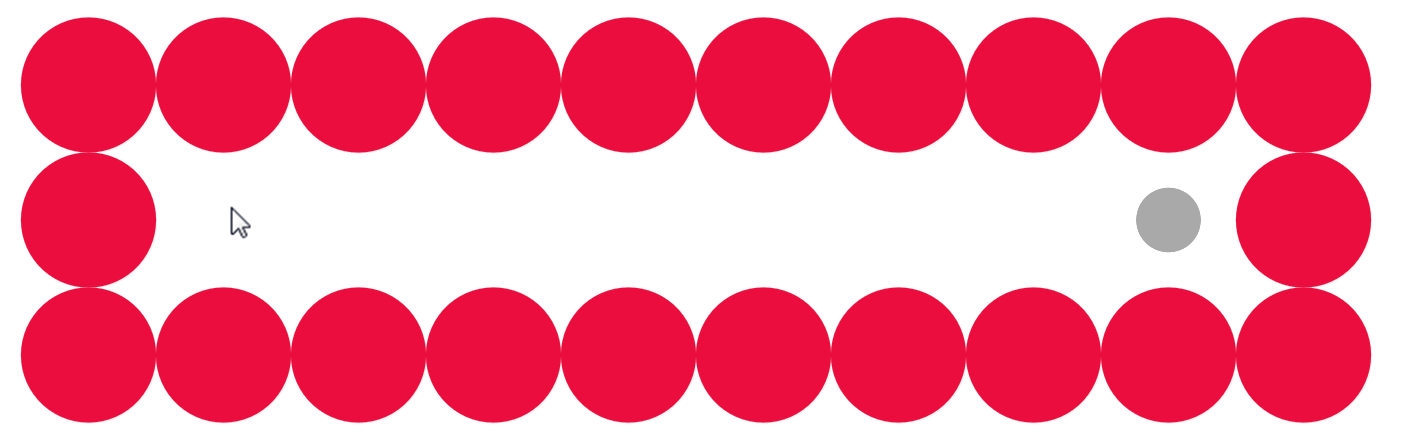
You start left, go right to the grey goal and would inexplicably touch the red circle in between. You see you ‘lost’ the level and restart it. This seemed fine as an idea, but in reality players kept bumping into the circle and had no idea what was happening.

A big reason for this problem was that players had no idea what this red circle meant, or what it would do. What does just a circle imply? It’s red, so that’s something, but it didn’t do enough to signal to players it was dangerous. Some even thought it was a coin to collect, which didn’t help either, but it did give light to an insight. If a lone circle can signify something like a coin, what could it do in combination with others? Something like this:

Suddenly a row of these signifies a wall. Put it all around the player and it implies the walls of a room. Now the first level is just this. It seemed weird as an introduction, but worked very well. The player goes through it, comes to have an understanding of it right away and doesn’t have to touch any to find out.

Function over visual

Make your game work before making it look good. A good looking game can have its function too, but don’t rely on it keep players playing. It can pull players in, but to keep them there, the game needs to be fun. If something looks amazing, but it’s more functional with lesser art, it’s probably the right call to go for function.

In Circles you go around avoiding circles. But at some point, these looked like rings. It looked a lot better, but they didn’t make it in the end. I ended up using full circles, they were easier to read from a quick glance and made it easier for players to see the negative space (non circles) in a level.

Fun over function

Not all elements in a game need to have a function. You can have a mechanic that’s just fun to play around with, but serves no real purpose. You see this with the basketball pre-match in Overwatch or just using the toilet in Bioshock Infinite. And you might notice that while these don’t have any mechanic function ingame, “outgame” they help to relax you a bit or just have a laugh.

With Circles, you can ‘eat up’ the circles at the end of each level. This serves some purpose before, but that got removed at some point. Now, it doesn’t really give you any points, or play into another mechanic, it’s just there to reward the player and give them so relief. It’s just fun to pick up the circles (that before you had to avoid) and see them explode afterwards.